
Catheter Training Is Not What Most People Think It Is
When a device development organization hears that an engineer wants to attend a catheter manufacturing workshop, the request usually gets processed through the same mental category as a conference, a certificate program, or a continuing education credit. It is filed as professional development — a nice-to-have for the engineer, a line item on the L&D budget, and a low priority against the pressing demands of the current program.
This categorization is wrong, and it has a real cost.
A serious catheter manufacturing workshop is not a professional development activity. It is a design-to-manufacturing translation exercise — and on programs where the design team has not been near production-grade equipment, the absence of that translation routinely shows up as rework, schedule slip, and design decisions that look reasonable on paper but fall apart at the build.
Why Catheter Design Is Unusually Coupled to Manufacturing
In many precision components, the design and manufacturing disciplines can operate somewhat independently. An engineer designing a machined part can specify geometry, tolerance, and material, and the manufacturing partner will execute against that spec. The coupling between design intent and production reality is real but bounded.
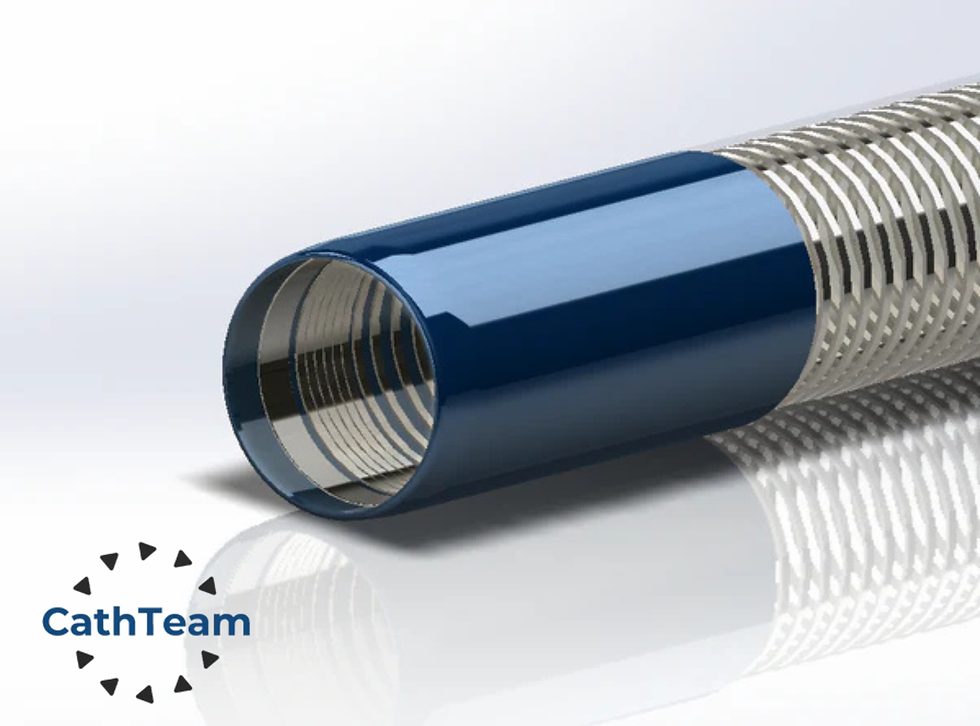
Catheter design does not work that way. The shaft construction is a layered system — a PTFE liner, a metallic braid or coil, a polymer outer jacket, and any embedded components like pull rings, electrodes, or sensors — and each layer is built sequentially through a manufacturing process that is itself the design. Braid angle determines torque response and column strength. Coil pitch determines bend characteristics and hoop strength. Lamination process determines how cleanly the layers bond, how consistent the outer diameter holds, and whether the construction survives the reflow cycle.
The design of a catheter, in other words, is not separable from the way it is built. The braid is not a component you specify and receive; it is a process that gets performed on the shaft during construction, and the choices made during that process define the device's performance. Same for the coil. Same for the lamination.
This means a catheter engineer who has never operated a braiding machine, who has never watched a coiler put pitch on a wire, who has never seen lamination performed on production-grade equipment — that engineer is making design decisions about processes they have not seen execute. Sometimes those decisions are sound. Often they are not, and the program finds out at prototype.
What Production-Grade Workshop Equipment Actually Teaches
The catheter training that compresses years of trial-and-error into days is the kind that puts engineers in front of the same equipment used in production. CathTeam, a Haldeman & Frazier principal that runs this kind of hands-on workshop, builds their courses around four manufacturing processes that map directly to the design decisions engineers struggle with most.
Braiding. On a Steeger braiding machine, engineers see how carrier configuration, braid angle, and wire selection translate into the catheter's flexibility, torque response, and column strength. The difference between a 50-pick-per-inch braid and a 80-pick-per-inch braid is not a number on a spec sheet — it is the way the shaft behaves in the hand. Engineers who have braided a shaft themselves specify braids differently than engineers who have not.
Coiling. Precision coil winding on a RothGreaves coiler shows how coil pitch, wire selection, and process control affect flexibility, hoop strength, and manufacturability — particularly on thin-walled catheter profiles where the margin for error is narrow. Coil specifications are easy to write and hard to execute. Watching the execution changes how the specifications get written.
Lamination. Convection and radiant lamination are the processes that bind the shaft construction into a single integrated structure. Lamination decisions affect dimensional consistency, layer adhesion, manufacturing speed, and the failure modes the device exhibits under flexion. Engineers who have run lamination understand which design choices make lamination easy and which ones create problems — the kind of intuition that does not develop from reading process specifications.
Design and process integration. The fourth area is the explicit conversation about how to make design decisions that account for manufacturing reality. Material selection, prototyping strategy, manufacturable construction. This is where the hands-on exposure converts into design practice the engineer takes back to their program.
What Programs Get Back
The return on a workshop investment shows up in places that are not always tracked back to the workshop itself.
Designs that come out of teams with hands-on manufacturing exposure tend to be more manufacturable on the first iteration. The braid spec is something the manufacturing partner can actually build. The lamination requirement does not exceed what the process can deliver. The outer diameter tolerance window accounts for the dimensional contributions of each layer rather than imagining the shaft can be controlled to a single specification.
Conversations with manufacturing partners become substantively different. An engineer who has run the equipment can discuss process trade-offs as a peer, ask precise questions, and recognize the difference between a real manufacturing constraint and a constraint that is actually a preference. This shortens negotiation cycles and reduces the iteration count between design release and first build.
Failure modes get understood earlier. When a prototype fails in a way that traces back to a braid or lamination choice, the engineer with hands-on exposure recognizes the root cause faster, sometimes immediately. The engineer without that exposure goes through a longer diagnostic cycle, sometimes including changes that are not actually addressing the root cause.
Where This Fits
For organizations developing catheter platforms — neurovascular, structural heart, electrophysiology, peripheral intervention, drug delivery — the question worth asking is how much of the design team has seen the manufacturing processes that define catheter construction execute on production-grade equipment. If the answer is "not much," the program is paying a tax that is not visible until rework cycles reveal it.
CathTeam runs their workshops in a working development facility — not a classroom, not a simulator, but the same kind of environment where catheters are actually made. The engineers leave with hands-on exposure to braiding, coiling, lamination, and design-process integration on the equipment that matters. Haldeman & Frazier has watched this kind of training meaningfully change how device development teams approach catheter design, particularly on early-stage programs where the design decisions have the longest leverage on the rest of the development cycle.
To discuss training opportunities for a device development team or evaluate CathTeam through Haldeman & Frazier, contact us.
Comments