
Catheter R&D Is Iteration-Heavy. Mandrel Sourcing Should Not Be the Bottleneck.
Catheter development at the early prototype stage runs on a specific rhythm: design a build, test it on the bench, learn something, change a dimension, try again. The cycles are short on purpose. The point of early R&D is to find out what works before committing to a direction, and that means trying configurations the team would not have tried if each attempt were expensive.
The hidden tax on this rhythm is mandrel sourcing.
A catheter build needs a mandrel — a precision-ground core that the construction is built around. When the team needs to try a different lumen size, a different shaft profile, or a different distal taper, they need a different mandrel. Ordering each one individually means a quote cycle, a lead time, a shipping wait, and a fresh PO for what is sometimes a single part. Multiply that by the number of variants a serious R&D effort works through in a quarter, and the cumulative delay is significant. The clock that matters in early development is not the manufacturing clock; it is the iteration clock. Mandrel sourcing puts a drag on the iteration clock that most programs accept without questioning.
The supply model is starting to change, and it is worth understanding why.
How Early-Stage Catheter R&D Actually Consumes Mandrels
For a team running active prototype work, mandrel demand does not look like a production BOM. It looks like a series of small, varied orders driven by design decisions that have not been made yet.
A neurovascular access catheter program might cycle through a dozen distal diameters before locking the design. A steerable catheter for structural heart work needs mandrels for the inner lumen, the outer profile, and the multiple sub-lumens for pull wires and accessory channels — and the team may iterate on each of those independently. A laser-cutting development effort needs mandrels in a wide range of sizes to support different stent and hypotube configurations. Venous access, peripheral intervention, electrophysiology mapping — each platform has its own dimensional profile, and each iteration potentially calls for a different mandrel.
The result is a procurement pattern that any catheter R&D engineer recognizes: a constant trickle of small mandrel orders, each waiting on the previous one to arrive, each delay compounding into the program timeline.
The Operational Shift: From Sourcing Each Mandrel to Stocking the Range
The shift that is starting to make sense for active R&D labs is treating mandrels less like a per-build purchase and more like a stocked resource. If a team is going to iterate across a known dimensional range, the cost-benefit on having that whole range available on-shelf — instead of ordering each piece as it is needed — tips in favor of stocking.
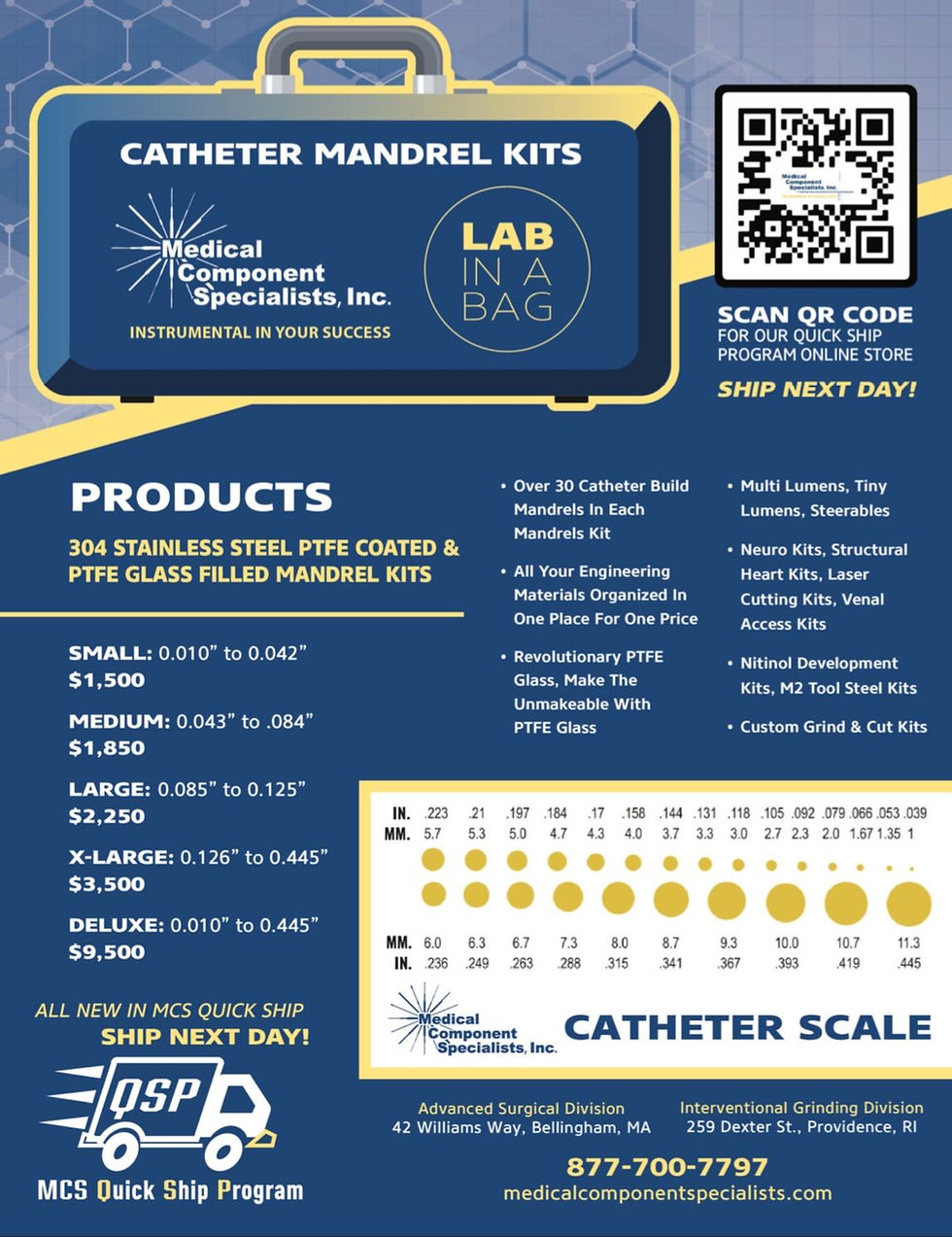
This is the logic behind Medical Component Specialists' (MCS) Catheter Mandrel Kits, which is the offering Haldeman & Frazier customers have been asking about most often in this category. The kits package 30+ catheter build mandrels in graduated diameters, in 304 stainless steel with PTFE or PTFE-glass-filled coatings, organized by size range:
Small kit: 0.010" to 0.042"
Medium kit: 0.043" to 0.084"
Large kit: 0.085" to 0.125"
X-Large kit: 0.126" to 0.445"
Deluxe kit: 0.010" to 0.445" (the full range)
For a team working on neurovascular or microcatheter platforms, the Small kit covers the relevant range. For structural heart or peripheral work, the Medium or Large fits. The Deluxe is for labs that work across the full diameter spectrum, often because they support multiple programs simultaneously.
The substantive question is not whether the kit pricing is favorable on a per-unit basis — it is whether having the dimensional range available on the bench changes how fast the team can iterate. For programs where the iteration clock is the binding constraint, it does.
What the Kit Format Specifically Solves
Three operational frictions disappear when the mandrel range is already on hand.
The quote-to-order cycle is gone for the iteration. A team trying a new lumen diameter on Monday morning does not have to wait for purchasing to issue a PO, the supplier to acknowledge, the part to grind, and the shipment to arrive. The mandrel is on the shelf. The iteration happens that day.
The size-decision pressure relaxes. When each mandrel order has a lead time attached, teams sometimes commit to a dimension before they should — because the cost of ordering the wrong one is a week of lost time. With the range stocked, the team can grab two adjacent sizes, try both, and let the build data drive the decision rather than the procurement constraint.
The mandrel supply stops gating bench time. R&D engineers have a finite amount of available bench time, and time spent waiting for parts is time the bench is idle for that project. Stocking the range converts mandrel waiting time into mandrel pulling time.
MCS also runs a Quick Ship program for individual mandrels and replacement components — next-day shipping on stocked sizes — which fills the gap when a specific dimension outside the kit range is needed urgently. The combination of the kit on-shelf plus quick-ship for outliers covers most of what an active catheter R&D lab needs.
Where This Lands
For OEM teams running catheter development programs — neurovascular access, structural heart, electrophysiology, peripheral intervention, laser-cut hypotube work, nitinol development — the practical question is how the program's iteration speed compares to its mandrel supply speed. If iteration is fast and mandrel sourcing is slow, the program is being held back by the slower of the two. The kit format removes that asymmetry.
Medical Component Specialists, one of the principals Haldeman & Frazier represents, has been the source most often pointed to for catheter mandrel kits specifically because the format is built around how catheter R&D actually consumes mandrels in early development. The kits are available across diameter ranges, the materials cover the standard requirements (304 stainless with PTFE and PTFE-glass-filled coatings), and the quick-ship program backstops the kits for sizes outside the standard range.
To discuss mandrel requirements for a catheter program or evaluate MCS through Haldeman & Frazier, contact us.
Comments